Summary
AR and VR are moving beyond showroom gimmicks in UAE real estate. From virtual property tours to AR-powered off-plan visualisation, immersive technology is changing how developers sell, how buyers make decisions, and what sales teams need to know. The real advantage isn't simply adopting the technology and it's training people to use it effectively.
Dubai's real estate sector was valued at AED 302 billion in 2024. That number gets referenced constantly. What gets mentioned less often is how a growing share of those transactions are now starting — and sometimes finishing — without a buyer ever walking into a showroom.
That shift didn't happen by accident. The developers driving it stopped thinking about AR and VR as marketing novelties somewhere around 2022 and started treating them as sales infrastructure decisions. That's a meaningful difference: in how you budget for the technology, who owns it internally, and what you actually expect it to return.

The government is reading the same signals. In May 2025, Sheikh Hamdan bin Mohammed directed the launch of the Dubai PropTech Hub — with a mandate to more than double the PropTech market's value to AED 4.5 billion within five years, supporting over 200 companies and attracting AED 1 billion in new investment by 2030. That's not a pilot program. That's a structural commitment to making digital-first real estate the default, not the exception.
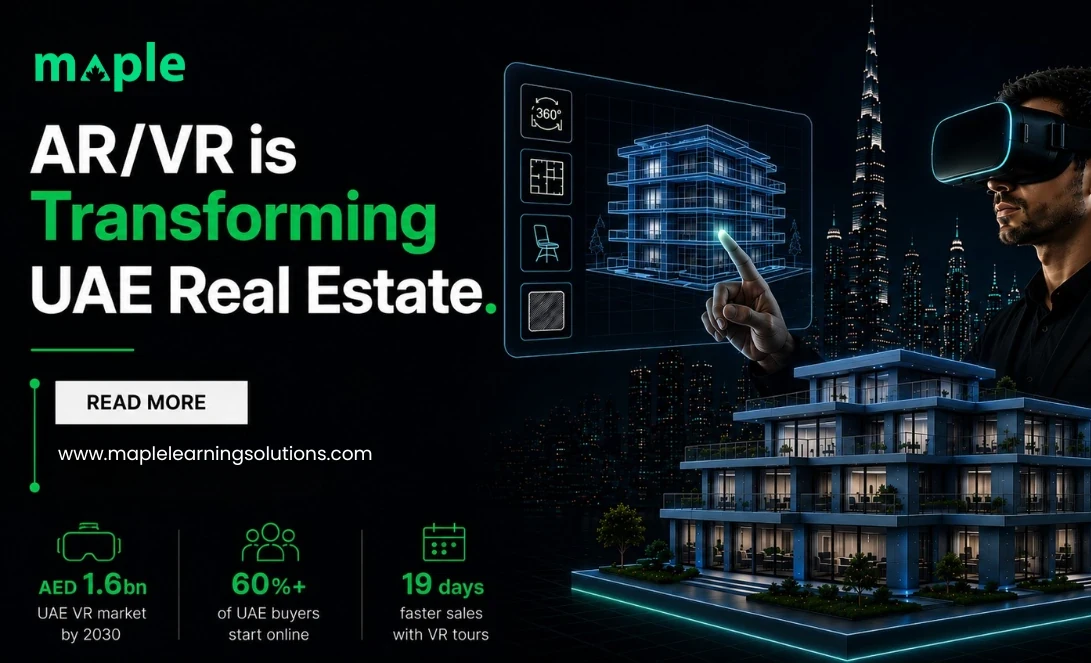
Some of the market's biggest names are already well into that transition. Emaar, Aldar, and Sobha — developers collectively responsible for a significant share of UAE residential supply — have all adopted virtual walkthroughs and digital booking as standard parts of their sales process. Worth noting: over 80% of property listings in Dubai and Abu Dhabi are already digitized, and more than 60% of buyers now initiate transactions through online portals. For the developers leading that shift, immersive technology is no longer a competitive edge. It's table stakes. For those still running primarily physical showroom operations, that gap is going to be increasingly difficult to ignore.
The business case for VR has shifted from aspirational to measurable. Research published in Information Systems Research in 2025 — based on actual platform transaction data, not a survey — found that properties with VR tours sold in an average of 19 days, versus 34 days for those without. Nearly half the time on market, compressed. For developers managing multiple off-plan launches simultaneously, that isn't a nice-to-have. It directly affects cash flow and project velocity.
AR plays a different but equally compelling role. The ability to let buyers overlay finishes, layouts, and furnishings on a space in real time — before a single floor tile has been laid — directly addresses the trust deficit that has historically slowed off-plan conversion. Buyers who can customize and visualize exactly what they're committing to make faster, more confident decisions. For UAE developers selling to international buyers who may never physically visit the site before signing, that capability closes a gap that no brochure, render, or scale model ever could. It's the closest thing to a physical viewing that geography allows.
"Technologies such as AR and VR are not just add-ons—they are redefining how properties are conceptualized, marketed, and sold in the UAE."

Here's the part most PropTech conversations skip over entirely. The technology is only as effective as the people using it. An AR-enabled showroom doesn't run itself. Sales teams need to know how to guide a buyer through a virtual experience without it feeling clunky or impersonal—because a badly handled VR walkthrough doesn't just fail to close the unit, it actively damages the buyer's confidence in the developer. Staff need to understand the tools well enough to troubleshoot when something goes wrong in real time, adapt when a buyer is unfamiliar with the technology, and keep the narrative of the property at the center of the experience—not the mechanics of the headset. That's a specific, learnable skill set. It needs to be built deliberately, not assumed.
Most organizations discover this the hard way—after a handful of showroom visits that didn't land the way they should have. The smarter approach is to treat AR and VR adoption as two parallel investments: the technology itself and the training that makes it actually work. Not a one-day induction and a user manual. Scenario-based, role-specific training that prepares sales staff for the real conditions of a showroom floor—difficult buyers, technical glitches, questions the render can't answer. One investment without the other is an incomplete strategy. In a market where buyer expectations are rising fast, incompleteness is expensive.
The UAE's property sector is moving quickly. The buyer appetite is already there. The government infrastructure is being built at pace. The gap between developers who've invested seriously in both the tools and the teams trained to use them and those who've done one without the other is going to become very visible, very soon.
Sources & Further Reading
All statistics linked to primary or credible secondary sources. Click any link to read the full original piece.
1. Dubai PropTech Hub Launch — UAE Government Media Office, May 2025.
Official announcement confirming Sheikh Hamdan's directive to launch the Dubai PropTech Hub. Target: AED 4.5 billion PropTech market value and over AED 1 billion in new investment by 2030.
2. UAE Real Estate Market Report 2025–2030 — Research and Markets via GlobeNewswire, October 2025.
Source for Emaar, Aldar, and Sobha virtual walkthrough adoption; 80%+ listings digitized in Dubai and Abu Dhabi; 60%+ of buyers initiating transactions via online portals.
3. VR Tours Reduce Days on Market: Peer-Reviewed Research — Information Systems Research, 2025.
Study by Zhenbin Yan and Yong Tan et al. based on real estate platform transaction data. Found VR tours cut average time on market from 34 to 19 days. Summarised by Phys.org, December 2025.
4. UAE VR Market to Hit AED 1.6bn by 2030 — Gulf Business, February 2026.
Citing Grand View Research. UAE VR market generated AED 366M in 2024; projected 28% CAGR to 2030, real estate identified as a primary growth driver.
Covers AR/VR adoption context, PropTech's role in UAE market growth, and buyer digitisation trends.
Similar Blogs you might like




Stay Updated
Unlock peak performance with Maple Learning Solutions. Insider tips, updates & announcements. Dominate the field, stay informed.