Summary
A single operator error can bring an entire production line to a halt, costing manufacturers hundreds of thousands in repairs, downtime, and lost productivity. This article explores why traditional onboarding methods often fail in high-risk manufacturing environments and how AR/VR simulation training enables employees to practice complex procedures in a safe, immersive setting before working with real equipment. Learn how manufacturers across the UAE and GCC can reduce operational risk, improve safety compliance, and accelerate workforce readiness through immersive learning solutions.
It was 7:42 AM on a Tuesday when the alarm went off.
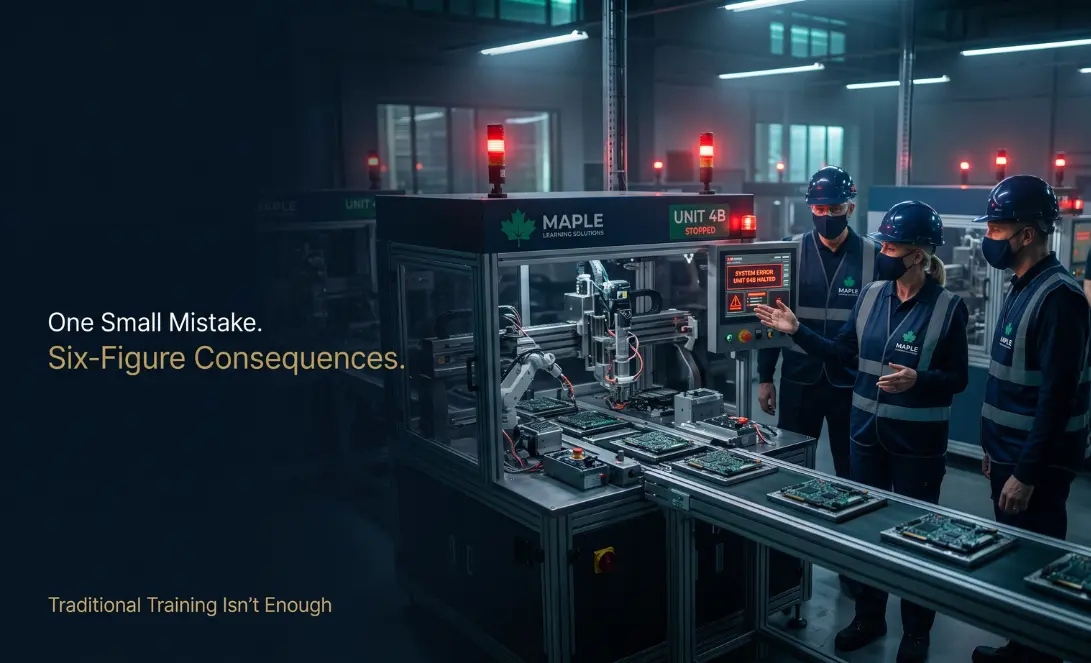
Not a fire alarm. Not an evacuation siren. Just the dull, metallic screech of an automated pick-and-place machine grinding to a halt mid-cycle — because a new hire, three days into the job, had loaded a component tray at the wrong angle.
No one was hurt. That's the part the plant manager kept repeating afterward, almost like he was trying to convince himself. No one was hurt. But the machine's calibration head was misaligned, the production line was down for six hours, and the repair — parts, technician flown in, lost output — came to just over AED 400,000. Six figures, gone, because of a mistake that took four seconds to make and should have taken zero.
He'd seen it coming, if he was honest. Not that exact moment, but a moment like it. New operators had been fumbling with equipment worth more than their annual salary for months. Onboarding consisted of a induction PDF, a 40-slide PowerPoint deck, and a supervisor walking the floor for half a day before handing over the controls. It had worked well enough for years — until the plant scaled up, hiring accelerated, and the margin for error quietly disappeared.
This is a familiar story across UAE and wider GCC manufacturing right now. Free zones are attracting new production lines faster than experienced operators can be trained. Machinery is more expensive and more automated than it was a decade ago. And the training methods most plants still lean on were designed for a slower, lower-stakes era.
The Problem: You Can't Learn to Handle a Complex Machine From a Slide Deck
Ask any L&D or operations lead in manufacturing what's broken about onboarding, and the answer is rarely "we don't have training." Almost every plant has training. The problem is what that training actually does — or doesn't do — to a new hire's brain.
Classroom and document-based training has three structural weaknesses on a factory floor:
It can't replicate real risk. A slide showing "correct hand placement" doesn't teach the muscle memory of correct hand placement. There's no consequence, no pressure, no sense of what happens if you get it wrong — so the first time a trainee feels real risk is the first time they're standing in front of the actual machine.
Retention collapses within days. Learning science has shown for decades that people forget the majority of passively delivered information within a week. A new hire who read a 40-page safety manual on day one has, realistically, retained a fraction of it by the time they're operating equipment on day four.
It doesn't scale with hiring speed. When a plant needs to onboard 30 operators in a month, one supervisor walking each person through the floor individually isn't a training program — it's a bottleneck, and a source of inconsistency between what each new hire actually learns.
The plant manager's near-miss wasn't a training failure in the sense that nobody tried. It was a format failure. The information was there. It just never had a chance to become instinct.
The Turning Point: Rethinking What "Training" Means
After the incident, the plant's leadership didn't reach for more slides or a longer induction manual. They asked a different question: what would it take for a new hire to make their mistakes somewhere other than in front of a real machine?
That question is exactly what pushed manufacturers across the region toward AR/VR simulation training — and it's the same question behind Maple's Safety Training in Electronics Manufacturing project, built specifically for high-value, high-risk production environments where a single wrong move has real financial and safety consequences.
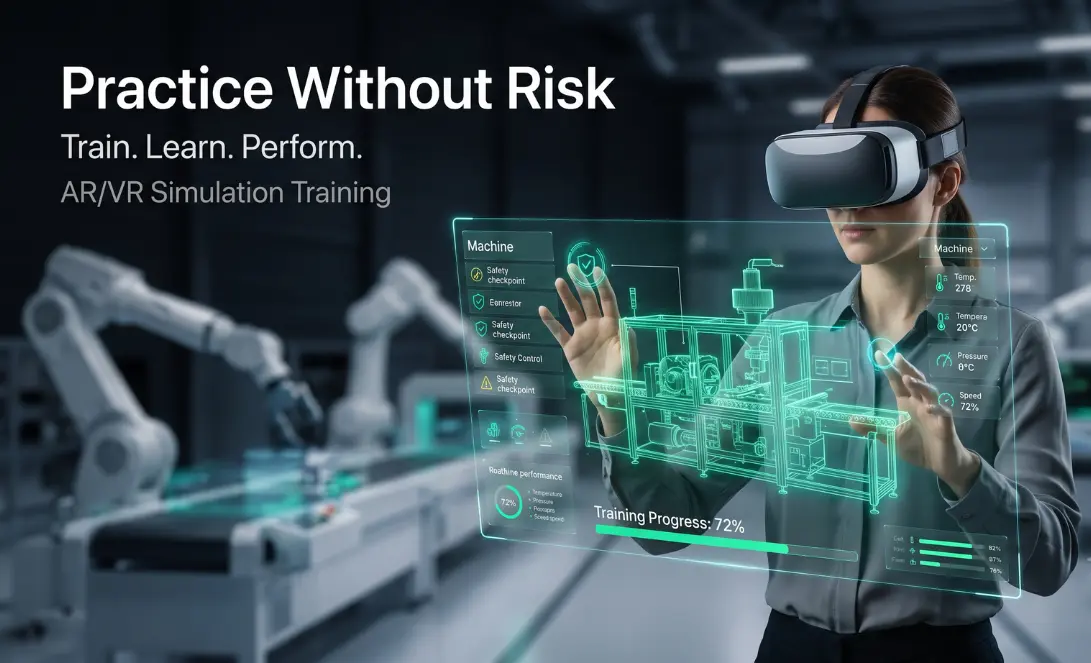
Instead of reading about correct machine handling, operators put on a headset and do it — repeatedly, in a fully simulated version of the production line, with mistakes that cost nothing but a restart.
The Solution: AR/VR Simulation Training, Built for the Factory Floor
When training moves beyond manuals and slide decks into immersive AR/VR simulations, employees gain practical experience before they ever step onto the production floor. Instead of learning by watching, they learn by doing—building confidence, competence, and consistency in a safe, controlled environment.
Mistakes become learning opportunities—not costly incidents.
In a virtual environment, trainees can misload a component, operate a machine incorrectly, or miss a safety step without risking equipment damage, production downtime, or worker safety. They can repeat scenarios until every procedure becomes second nature.
Skills are developed through practice, not observation.
Reading about a process and performing it are two very different experiences. AR/VR places trainees inside realistic factory scenarios where they interact with machinery, follow standard operating procedures, and respond to real-world challenges. This hands-on repetition helps build the confidence and muscle memory needed for high-pressure production environments.
Training becomes measurable and data-driven.
Every interaction within a simulation can be tracked—from task completion time and procedural errors to hesitation points and overall improvement across multiple sessions. Instead of relying solely on attendance records or written assessments, learning and development teams gain objective insights into employee readiness and can identify who is prepared for independent work and who would benefit from additional coaching.
High-quality training can be delivered at scale.
Whether onboarding a handful of employees or an entire production shift, AR/VR simulations provide every trainee with the same standardised learning experience. Multiple employees can train simultaneously without requiring constant supervision, reducing the burden on experienced operators while maintaining consistent training quality across locations.
The impact of immersive training is backed by research. A study by PwC found that VR learners completed training up to 4× faster than classroom learners and were 275% more confident in applying what they learned. At larger scales, VR training also became 52% more cost-effective than traditional classroom-based programmes, demonstrating that immersive learning can improve both workforce readiness and training efficiency.
For manufacturers across the UAE and GCC—whether in electronics, pharmaceuticals, automotive components, food processing, or heavy industry—AR/VR simulation training is more than an emerging technology. It provides employees with a safe environment to practice, make mistakes, and master critical procedures before they work with real equipment, reducing operational risk while building a more skilled and confident workforce.
What This Looked Like in Practice
Maple's approach to electronics manufacturing safety training focused on recreating the specific machinery, hazards, and procedural sequences operators would actually face — not a generic "factory safety" module, but a simulation modeled on the real production environment. The goal wasn't to replace hands-on floor time entirely, but to make sure the first time an operator handles the real equipment isn't also the first time they've handled anything like it.
That distinction matters. Blended learning — VR simulation for the high-risk, high-cost procedures, paired with shorter real-world floor time for final sign-off — consistently outperforms either method used alone, because it front-loads the mistakes into the environment where they're cheapest.
Why This Matters More in the GCC Right Now
Manufacturing across the UAE, KSA, and Bahrain is scaling as part of broader industrial diversification strategies. That means more new-hire volume, more automated and imported machinery with steep learning curves, and — increasingly — a regulatory and insurance environment where documented, measurable safety training isn't just good practice, it's an audit requirement.
A plant that can show data – completion rates, error reduction across repeated attempts, and time-to-competency – is in a fundamentally stronger position than one that can only show a signed attendance sheet for a PowerPoint session.
The Real Lesson From the Six-Figure Mistake
The plant manager's near-miss wasn't really about one careless new hire. It was about a training system built for a slower, lower-stakes era being asked to prepare people for machinery it was never designed to teach safely.
The fix wasn't more paperwork. It was giving people a place to fail safely, enough times, before the stakes became real.
If your onboarding still lives entirely in a binder or a slide deck, it might be worth asking the same question that Plant asked after 7:42 AM that Tuesday: what would it take for our new hires to make their mistakes somewhere other than on the production line?
Further Reading
PwC — Understanding the Effectiveness of VR Soft Skills Training in the Enterprise. PwC's landmark 1,600-participant enterprise study found VR learners completed training up to 4x faster than classroom learners and were 275% more confident applying what they'd learned. It also documents the cost-parity point (375 learners) at which VR training becomes cheaper than classroom instruction at scale.
RAUM — Enterprise VR in 2026: Headsets, Use Cases, Costs & How to Deploy at Scale. Covers real enterprise deployments including Tyson Foods' documented 20%+ reduction in workplace injuries after VR safety training, plus practical guidance on device management and rollout at scale.
A Survey Study to Understand Industry Vision for VR/AR Applications in Design and Construction (arXiv). Academic research comparing long-term retention outcomes between VR-based and traditional safety training approaches, with findings favoring VR in both short- and long-term recall.
Fire Safety Training for Workers: VR Learning Modalities and Performance (PMC/NCBI). A controlled study comparing video-based training against active VR training for procedural safety tasks, showing VR groups outperformed on execution time, error rates, and overall score.
Similar Blogs you might like




Stay Updated
Unlock peak performance with Maple Learning Solutions. Insider tips, updates & announcements. Dominate the field, stay informed.