Summary
This blog explains why people are both the biggest risk and strongest recovery asset in business continuity planning. It highlights the importance of BCP training, HR crisis preparedness, employee readiness, and crisis simulations in building a resilient organization.
We Harden Systems, But Forget the People Behind Them
We spend enormous energy hardening our systems. Firewalls. Redundant servers. Cloud
backups. Failover protocols. And yet, when a real crisis hits, it's almost never the technology that breaks first. It's the people.
Not because they're incompetent. Because nobody prepared them.
The 2 AM Crisis Nobody Is Ready For
Picture this. It's 2 AM. A ransomware attack has just encrypted your production environment. The on-call engineer escalates—but the incident lead listed in the BCP left the company seven months ago. Nobody updated the document. The backup contact is on paternity leave. By the time the right people are in a bridge call, ninety minutes have passed. At $9,000 a minute, you've already lost over half a million dollars. And you haven't even started recovering yet.
For unprepared organizations, this isn't the nightmare scenario. It's the average one.
Human Error Is Now a Business Continuity Risk
In 2024, human error surpassed technological flaws as the leading contributing factor to
data breaches — with 95% of breaches involving some form of human mistake. Read that
carefully. The technology held up. The human layer didn't. And yet, when most organizations review their BCP, they spend the majority of their time on systems and almost none on the people operating them under pressure.
Outdated Contact Lists Can Break the Entire Response Chain
Staff turnover alone invalidates nearly 30% of continuity contact lists within six months. So before a single system fails, your human response chain is already broken — quietly, invisibly, and without anyone raising a flag.
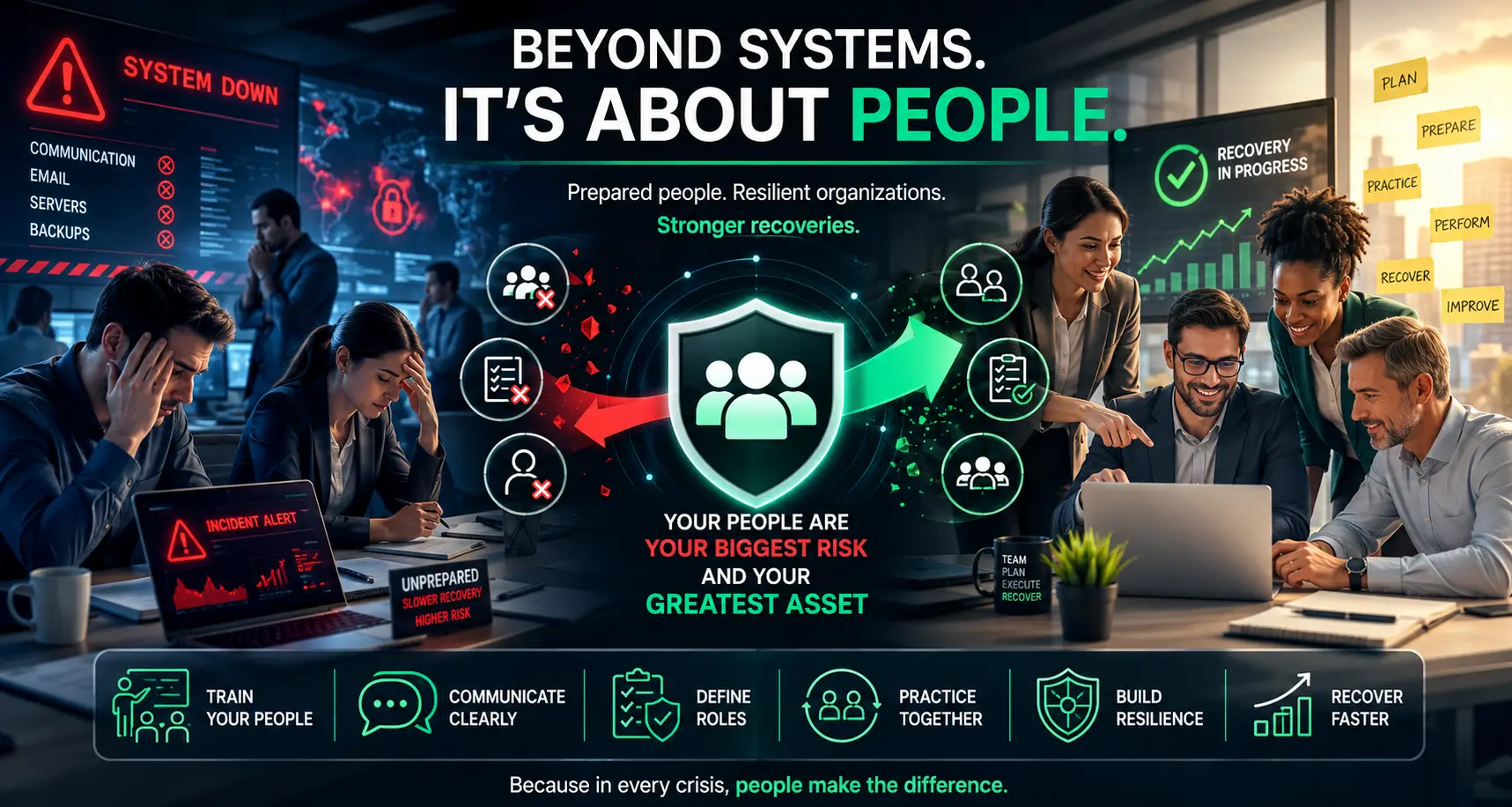
And then there's the pressure itself. Crises don't arrive during business hours when everyone is calm and rested. They arrive at the worst possible moment. In 2024, only 31% of U.S. employees reported being engaged at work — the lowest level in a decade. A disengaged workforce on a normal day becomes a paralyzed one when the floor drops out.
More than two-thirds of companies experienced downtime directly caused by human error — not ransomware, not hardware failure. People making the wrong call, at the wrong
moment, because they were never prepared for the one they were suddenly living in. This isn't about blame. It's about what leadership chose to invest in before the crisis arrived. 83% of business and IT executives admitted the July 2024 global IT outage caught them completely off guard—exposing deep gaps in their preparedness. Not their infrastructure. Their preparedness. Their people didn't know what to do, who to call, or how to communicate externally while systems were down. The technology recovered faster than the humans managing it.
HR Belongs at the Center of BCP Planning
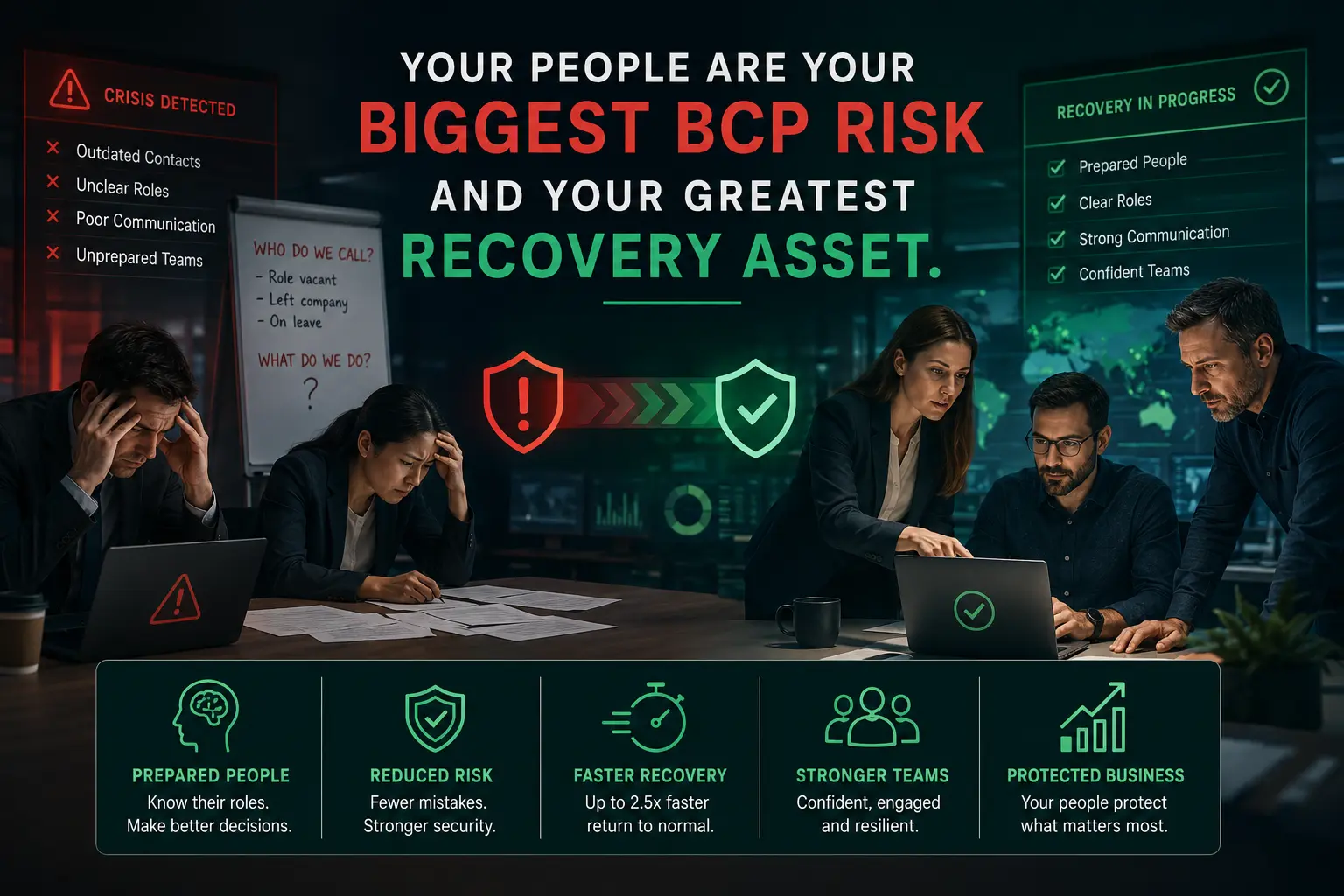
Here's the harder truth for HR and people leaders specifically: your function sits at the center of this problem, and most BCPs don't even mention you. Who manages employees?
communications during a crisis? Who tracks which critical roles are suddenly vacant? Who ensures that teams running a 72-hour recovery window don't completely unravel under the pressure? These aren't IT questions. They're people's questions. And right now, most Continuity plans leave them entirely unanswered.
If HR isn't in the room when the BCP gets written, the plan isn't finished. Full stop.
But here's what genuinely gives me confidence when I see organizations get this right—those same people who represent your biggest risk become your greatest recovery asset when they're prepared.
Trained employees make faster, better decisions under pressure. People who've sat through the uncomfortable tabletop scenarios—the ones where someone realizes mid-drill they Have no idea what to do—don't freeze when it's real. Security awareness training alone reduces phishing click rates by 86%. One investment. One number. The entire human risk profile of the organization shifts.
Here's the one that should stop every leader cold: companies that invest in employee crisis Training recovers from disruptions up to 2.5 times faster than those that don't. Not marginally faster. Two and a half times.
Your people built this organization. When they know what's expected of them—when
leadership has done the work of preparing them—they will fight to protect it in ways no system ever could. So ask yourself honestly. Not as a compliance exercise. As a leader.
When did you last run a drill that made your teams genuinely uncomfortable? When did HR last sit in the BCP review—not as a note-taker, but as an equal stakeholder? When did you Last, verify that every person named in your response plan still works here, still knows their role, and could execute it at 2 AM without being walked through it?
The binder means nothing if the people it depends on were never truly prepared.
And the crisis? It won't wait for you to figure that out.
Further Reading & Sources
SC Media — 95% of Data Breaches Involve Human Error
GCG Enterprise Solutions — IT BCP 2026 Resilience Guide
High5Test — Employee Wellbeing & Mental Health Statistics 2024–2025
InvenioIT — 25 Disaster Recovery Statistics Every Business Should Know
BusinessWire / PagerDuty — 88% of Execs Expect a Major Incident in 2025
Total Assure — Human Error Cybersecurity Statistics 2025
Ponemon Institute — Cost of IT Downtime & Recovery Report
Similar Blogs you might like




Stay Updated
Unlock peak performance with Maple Learning Solutions. Insider tips, updates & announcements. Dominate the field, stay informed.