Summary
The blog argues that UAE manufacturers can no longer rely on manuals and classroom training as Operation 300bn accelerates factory-floor complexity. It backs this with hard data — PwC's findings on emotional connection, speed, and focus in VR learners; safety improvements (40% fewer assembly errors, 43% fewer lost-time injuries); Boeing's quality gains; and the PwC Middle East/Nakheel Properties pilot — before laying out the ROI case (30–70% cost savings, cost parity at 375 learners, 80% year-one retention) and closing with a CTA inviting reader engagement.
Walk into most manufacturing facilities in the UAE today and you'll still see the same training approach: a manual, a classroom, maybe a video. Meanwhile, the factory floor is getting smarter, faster, and more complex by the day.
Something has to give.
The Training Gap Is Real
UAE manufacturing is evolving rapidly under initiatives like Operation 300bn, which aims to grow the sector's contribution to AED 300 billion by 2031. That ambition demands a workforce that can keep pace. Yet the numbers tell a sobering story.
Research from Q4 2024 found that 60% of UAE employees fear their skills will become obsolete—and only 22% are satisfied with the upskilling programs their employers provide. Meanwhile, 87% of UAE companies expect increased demand for technological literacy, and according to the World Economic Forum, 41% of UAE workers will need to fundamentally transform their core skills between 2025 and 2030.
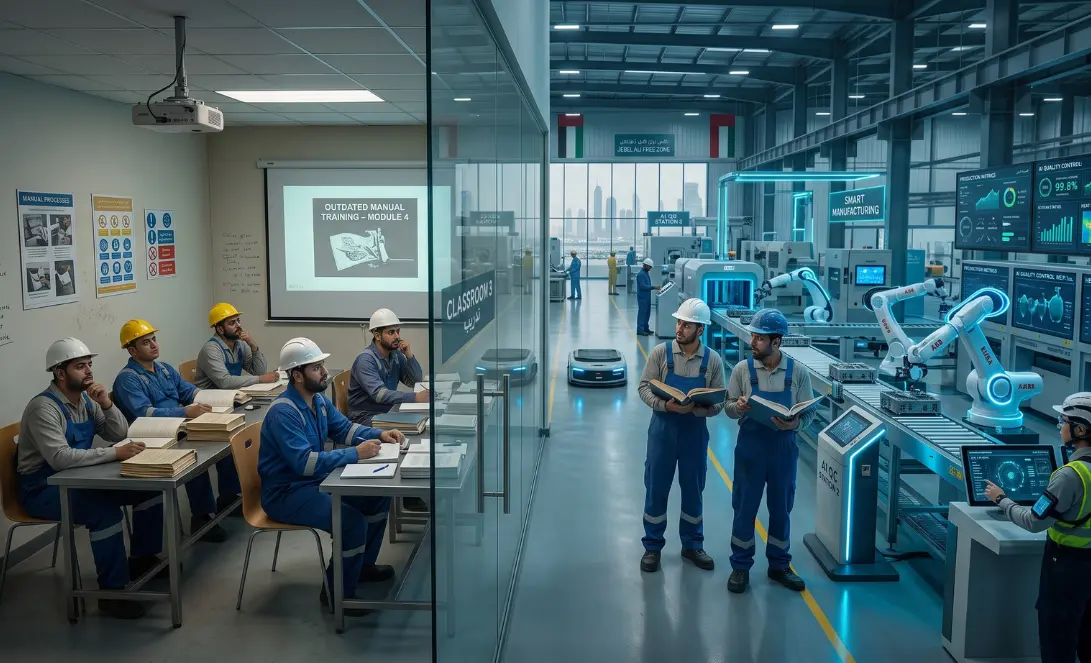
In manufacturing specifically, the pressure is even more acute. Modern facilities are
integrating robotics, IoT sensors, and AI-driven quality control faster than traditional
training methods can support. The challenge isn't just teaching workers new tools—it's doing so quickly, safely, and at scale across a diverse, multilingual workforce.
Traditional classroom training wasn't built for this. And that gap is becoming expensive.
What the Research Actually Shows
This is where VR and AR are genuinely changing the conversation—not as a technology experiment, but as a proven training solution.
PwC's landmark study found that VR learners felt 3.75 times more emotionally connected to training content than those in classroom settings. Emotional connection isn't a soft metric—it's one of the strongest predictors of knowledge retention and real-world application. The same study found VR learners completed training four times faster than classroom peers and were four times more focused than e-learning participants.
The safety numbers are even more compelling. Manufacturing plants using VR reported up to a 40% reduction in assembly errors. In mining—an industry with similar high-risk dynamics to UAE petrochemicals—VR safety training led to a 43% decrease in lost-time injuries. Boeing reported a 90% increase in first-time quality in employee training after implementing VR and AR technology.
Think about what that means for a technician learning to operate complex machinery or respond to an equipment failure. The difference between watching a demonstration and actually "doing it" in a safe, immersive simulation isn't just engagement—it's confidence, competence, and fewer costly mistakes on the real floor.
PwC Middle East has already validated this locally. Their Academy piloted VR-based leadership training with Nakheel Properties in the UAE, incorporating immersive simulations into a blended learning curriculum—with measurable results in engagement and skill application.

Where UAE Manufacturers Are Already Winning
AR is making quiet but significant inroads across UAE industrial facilities. Workers equipped with AR overlays can see real-time data, step-by-step guidance, and error alerts directly on the equipment in front of them - without stopping to consult a manual or wait for a supervisor.
The result? Fewer errors, less downtime, and faster onboarding for new hires. For sectors
with high workforce turnover or large volumes of new starters, that onboarding acceleration alone delivers measurable ROI.
VR goes a step further - enabling workers to train on high-risk scenarios (equipment failures, emergency protocols, hazardous material handling) without any real-world risk. For UAE's petrochemical, construction, and heavy manufacturing sectors, this isn't just convenient. It's transformative.
The Business Case Is Getting Harder to Ignore
Let's talk numbers - because this is ultimately what makes or breaks any investment
decision.
On average, companies save 30-70% on training costs when they move to virtual training - through reduced travel, facility costs, instructor time, and lost productivity. At scale, PwC data shows VR training achieves cost parity with classroom training at just 375 learners, and becomes 52% more cost-effective at 3,000 learners.
The indirect savings are equally significant. Workplace turnover alone costs manufacturing companies an average of $36,723 per employee lost. Better training directly improves retention. And with VR training shown to deliver knowledge retention rates of up to 80% one year after training - compared to just 20% one week after traditional training - the compounding value is undeniable.
The UAE AR/VR market is projected to reach $204.2 million by 2029, growing at nearly 10% annually. Early movers in manufacturing aren't adopting this technology because it's trendy. They're doing it because the numbers are adding up: fewer injuries, faster onboarding, lower error rates, stronger retention, and a tangible competitive advantage in attracting talent that wants to work for forward-thinking employers.
For L&D and HR leaders in UAE manufacturing, the question is no longer "is this technology ready?" It's "how much longer can we afford to wait?"
Are you exploring VR or AR in your manufacturing operations? I'd love to hear what's
working, what isn't, and where you see the biggest opportunity.
Sources & Further Reading
Similar Blogs you might like




Stay Updated
Unlock peak performance with Maple Learning Solutions. Insider tips, updates & announcements. Dominate the field, stay informed.