Summary
Immersive learning is changing employee training by giving employees opportunities to practise real-world situations through AR and VR. Explore how immersive experiences can improve engagement, build practical skills, provide feedback and prepare employees for workplace challenges.
Employee training is becoming more practical. Employees are increasingly expected to apply knowledge in situations that require quick decisions, problem-solving and hands-on skills.
A safety team may need to respond to an emergency. A technician may need to operate unfamiliar equipment. A customer service employee may need to handle a difficult customer interaction.
Traditional training can explain what employees should do, but explaining a situation is not always the same as experiencing it.
This is where immersive learning is becoming increasingly important.
Using technologies such as augmented reality (AR) and virtual reality (VR), organisations can create realistic learning environments where employees can practise tasks, explore scenarios and make decisions in a controlled setting.
Instead of simply learning about a situation, employees can experience it.
Moving from Information to Experience
Traditional employee training often relies on presentations, documents, videos and classroom sessions. These methods can be effective for introducing information, but some skills require more than knowledge.
They require practice.
For example, an employee may understand the steps involved in responding to a workplace emergency. However, knowing those steps does not necessarily prepare them to make decisions when the situation actually occurs.
Immersive learning can recreate these situations in a safe environment.
Employees can explore virtual workplaces, identify risks, follow procedures and make decisions without being exposed to the consequences of a real-world mistake.
This creates an opportunity to learn, practise and improve.
Why Realistic Scenarios Matter
The value of immersive learning comes from its ability to recreate situations employees may encounter in their actual roles.
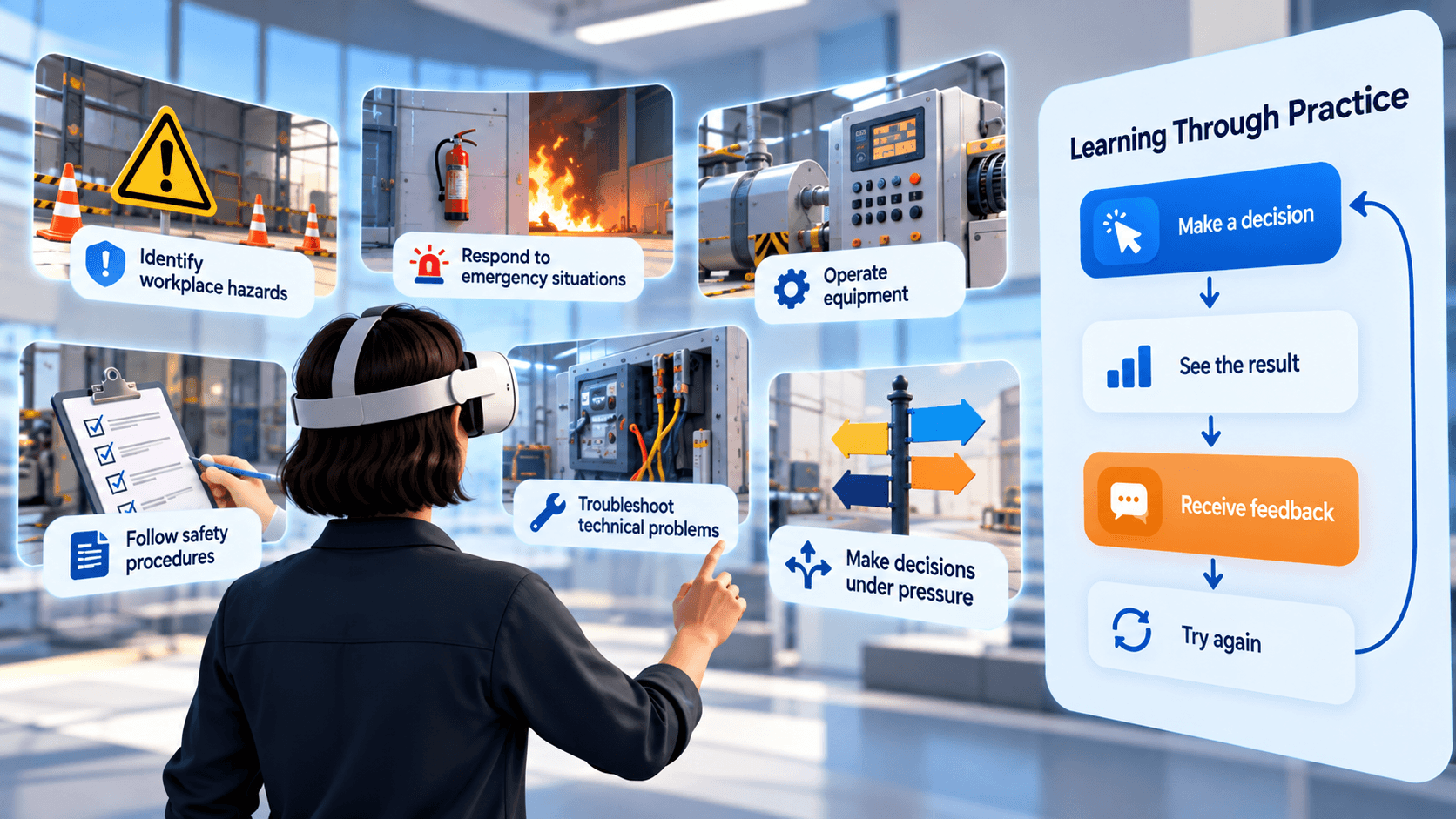
Training scenarios can help employees practise:
Identifying workplace hazards
Responding to emergency situations
Operating equipment
Following safety procedures
Troubleshooting technical problems
Making decisions under pressure
Employees are not simply reading about what should happen. They are actively deciding what to do.
This makes training more closely connected to real workplace situations.
Learning Through Practice
One of the biggest advantages of immersive learning is the opportunity to practise without real-world risk.
Employees can make a decision, see the result, receive feedback and try again. If they make the wrong choice, they can understand what could have been done differently before facing the same situation in real life.
This is particularly useful for safety, technical procedures, risk management and decision-making.
Practice turns knowledge into capability.

Making Learning More Engaging
Immersive learning encourages employees to participate more actively.
Instead of simply watching a training video, employees can interact with scenarios, make choices, complete tasks and receive feedback.
Gamification can also introduce challenges, goals and progress indicators to encourage participation and make learning more engaging.
The objective is not simply to make training entertaining. It is to encourage employees to participate, practise and improve.
Measuring Learning Beyond Course Completion
Completing a course does not always show whether an employee can apply what they have learned.
Immersive learning can provide insights into decisions, interactions, progress and scenario performance. These insights can help organisations identify where employees are performing well and where additional practice may be needed.
The learning process becomes:

Immersive Learning as Part of a Wider Strategy
AR and VR do not need to replace traditional training. They can work alongside eLearning, LMS platforms, assessments, Gamification and instructor-led training.
For example, an employee could first complete an eLearning module, practise the process through a VR simulation and then complete an assessment.
The future of employee training is not simply about giving employees more information.
It is about giving them opportunities to experience, practise, apply and improve.
Further Reading
Similar Blogs you might like




Stay Updated
Unlock peak performance with Maple Learning Solutions. Insider tips, updates & announcements. Dominate the field, stay informed.