Summary
Business continuity planning helps organizations prepare for disruptions, protect critical operations, respond effectively, and recover stronger.
Why Is Business Continuity Planning Essential for Organizational Resilience?
A business can have a strong strategy, talented employees, reliable technology, and healthy revenue — and still be vulnerable when something unexpected happens.
A cyberattack can take systems offline. A supplier failure can interrupt production. Extreme weather can prevent employees from reaching a workplace. A power outage can stop critical operations. Even the loss of a few key employees can create serious operational gaps.
The real question isn't whether your organization will ever face disruption. It's whether your organization knows what to do when disruption happens.
That's where business continuity planning becomes essential.
Business continuity planning gives organizations a structured way to identify critical operations, prepare for disruption, respond effectively, and recover with as little impact as possible. ISO 22301 describes a business continuity management system as a framework for preparing for, responding to, and recovering from disruptive incidents while continually improving organizational resilience.
Why Traditional Risk Planning Isn't Enough
Many organizations have risk registers, emergency contacts, backup systems, and documented procedures.
But having a document isn't the same as being prepared.
A continuity plan that has never been tested may fail when employees actually need to use it. A crisis procedure written two years ago may no longer reflect current systems, suppliers, locations, or responsibilities.
This creates several common problems:
Employees aren't sure who makes decisions during a crisis.
Critical processes aren't clearly prioritized.
Backup procedures exist but haven't been tested.
Teams don't know how to communicate when normal channels fail.
Third-party and supply-chain dependencies aren't fully understood.
Recovery priorities aren't aligned with actual business requirements.
Effective business continuity management addresses these gaps by connecting planning with people, processes, technology, communication, and continuous testing.
Know Your Readiness Score
How prepared is your organization for its next disruption? Find out where your business stands today. Take the next step toward stronger business continuity and organizational resilience.

The Four Stages of Effective Business Continuity Planning
1. Identify: Understand What Could Disrupt the Business
The first step isn't writing a recovery plan.
It's understanding what needs to be protected.
Organizations need to identify critical processes, important assets, essential employees, technology dependencies, suppliers, communication channels, and potential vulnerabilities.
This is where risk assessment and business impact analysis become important. The goal is to understand what happens if a critical function stops — and how long the organization can realistically operate without it.
A useful question is:
"If this process stopped tomorrow, what would be affected first?"
The answer helps organizations prioritize their continuity efforts instead of treating every process as equally critical.
2. Build: Develop Practical Continuity Strategies
Once critical operations and risks are understood, organizations can build continuity strategies around them.
This may include:
Alternative work locations
Remote-work capabilities
Backup technology and data
Emergency communication procedures
Supplier alternatives
Cross-training employees
Crisis leadership structures
Emergency response procedures
Recovery priorities
The objective isn't to eliminate every possible risk. That's unrealistic.
The objective is to make sure the organization can continue delivering critical products or services at an acceptable level during disruption and recover systematically afterward.
That's also consistent with the purpose of ISO 22301, which provides a structured approach for organizations to prepare for disruptive incidents, respond to them, and continually improve their business continuity capabilities.
3. Test: Find the Gaps Before a Real Crisis Does
This is the step many organizations underestimate.
A plan may look perfect on paper and still fail in practice.
That's why continuity exercises, simulations, tabletop exercises, and crisis drills are so important.
For example, imagine a company discovers that its primary technology environment is unavailable for eight hours.
Who activates the continuity plan?
Who communicates with customers?
Which employees are essential?
How does the team access critical information?
What happens if the primary communication platform is also unavailable?
A simulation exposes these gaps while there is still time to fix them.
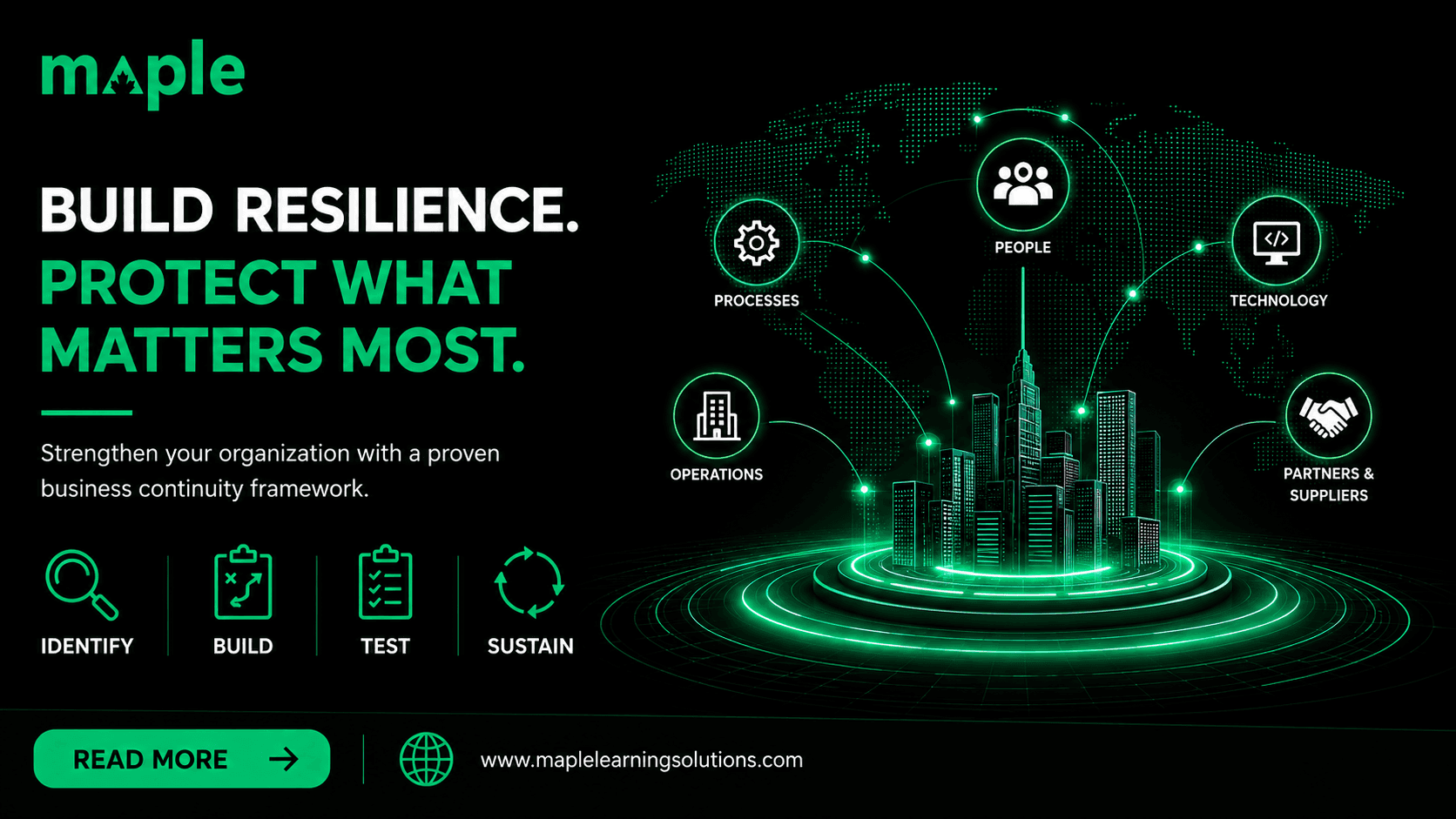
The GCC Business Continuity Planning platform follows this principle through a Identify, Build, Test, and Sustain framework, emphasizing simulations and continuous improvement rather than treating continuity planning as a one-time document exercise.
4. Sustain: Make Resilience Part of the Culture
Business continuity isn't something an organization completes once and files away.
Employees change. Technology changes. Suppliers change. Regulations change. Business priorities change.
That means continuity strategies need to evolve too.
Regular training, exercises, reviews, metrics, and updates help keep the organization prepared.
The strongest organizations don't treat resilience as the responsibility of one business continuity manager. They make preparedness part of the wider organizational culture.
Why Workforce Resilience Matters
Technology can provide backups, but people still make critical decisions during a disruption.
Employees need to know:
What their role is during an emergency
Who they report to
How they should communicate
Which processes take priority
Where to find emergency procedures
How to continue working if normal systems are unavailable
This is why workforce resilience should sit alongside technology and operational planning.
The GCC Business Continuity Planning platform specifically includes workforce resilience and response training, remote-work and digital operations, safety and security awareness, healthcare and emergency services, and government and defense upskilling as areas of resilience development.

Business Continuity Is Becoming More Important in 2026
Organizations are operating in an environment where risks are increasingly interconnected.
The World Economic Forum's Global Risks Report 2026 describes uncertainty as a defining feature of the current global risk environment. Its research also highlights concerns around geopolitical confrontation, economic volatility, technology, infrastructure, supply chains, and other interconnected risks. The report draws on the views of more than 1,300 experts and decision-makers.
For businesses, this means continuity planning can't focus on only one scenario.
A resilient organization needs to consider how different disruptions could interact.
For example:
Cyberattack → system outage → operational delays → customer impact → revenue loss
Or:
Supplier disruption → material shortage → production slowdown → missed delivery → customer dissatisfaction
Business continuity planning helps organizations understand these dependencies before they become expensive real-world problems.
Why ISO 22301 Matters
Organizations looking for a structured approach to business continuity can use ISO 22301 as a reference framework.
ISO explains that the standard is designed to help organizations establish, implement, operate, monitor, review, maintain, and continually improve a Business Continuity Management System. It is intended to support resilience against disruptive incidents and improve an organization's ability to respond and recover.
Importantly, ISO 22301 isn't limited to one industry or company size. The standard is designed to be applicable to organizations of different types, sizes, and operating environments.
That makes it particularly useful for organizations that want to move from informal emergency procedures toward a more structured business continuity management approach.
What Should Organizations Measure?
A continuity program shouldn't be judged only by whether a document exists.
Organizations should also monitor indicators that show whether they are actually becoming more resilient.
Examples include:
Critical processes with documented recovery strategies
Completion of continuity training
Exercise and simulation performance
Time required to activate response procedures
Identified risks that have been mitigated
Recovery time performance
Employee preparedness
Supplier continuity readiness
Corrective actions completed after exercises
The GCC Business Continuity Planning platform emphasizes measurable resilience, including operational readiness, risk mitigation, and continuity health rather than relying entirely on subjective assessments.
The Real Question Isn't "Do We Have a Business Continuity Plan?"
A better question is:
"Can our people actually execute it when normal operations fail?"
If the answer isn't clear, the organization may have a plan — but it may not yet have resilience.
Effective business continuity planning connects risk identification, continuity strategies, employee preparedness, crisis response, testing, and continuous improvement into one system.
That is the difference between simply having a document and building an organization that can adapt when disruption occurs.
Further Reading
GCC Business Continuity Planning Certification — business continuity, workforce resilience, preparedness, and operational resilience
ISO 22301 Business Continuity Management Systems — official ISO framework for business continuity management
Global Risks Report 2026 — current global risk and resilience outlook
NIST Contingency Planning Guide — guidance on contingency planning for information systems
External Resources
ISO — ISO 22301 — international standard for Business Continuity Management Systems
World Economic Forum — Global Risks Report 2026 — current research on interconnected global risks and resilience
NIST — Contingency Planning Guide — guidance for information-system contingency planning
Ready to move beyond a business continuity document and build measurable organizational resilience? Explore GCC Business Continuity Planning and see how a structured approach can help your organization identify risks, build continuity strategies, test preparedness, and sustain resilience.
Similar Blogs you might like




Stay Updated
Unlock peak performance with Maple Learning Solutions. Insider tips, updates & announcements. Dominate the field, stay informed.