Summary
UAE manufacturers report that falls and machinery-related incidents remain among the leading causes of workplace injury, and MOHRE's reporting rules put real financial and compliance weight behind every incident. Classroom-based safety training struggles to replicate the pressure and unpredictability of an actual factory floor, which is exactly where most accidents happen. This post covers why traditional industrial safety training leaves gaps, how VR-based simulation closes them, what a UAE manufacturer should look for in a training partner, and how to build a safety training programme that satisfies both compliance requirements and the people actually doing the job.
The Real Cost of a Gap in Industrial Safety Training
Every UAE employer is required to notify MOHRE within 48 hours of any workplace injury or death, and companies with 50 or more workers must maintain a formal system for monitoring work injuries and occupational diseases, including training programmes for anyone in high-risk roles (UAE government portal). That's not a paperwork exercise — it's a signal of how seriously incident prevention is taken at a regulatory level, and it puts pressure on manufacturers to prove their training actually works, not just that it happened.
The problem is that most industrial safety training still happens in a classroom, with a slideshow, months before a worker ever faces the situation the training was meant to prepare them for. By the time a genuine hazard shows up—a machinery malfunction, a confined space entry, a chemical spill—the training has faded into theory. Manufacturers end up compliant on paper and exposed on the floor.
Why VR Safety Training Closes That Gap
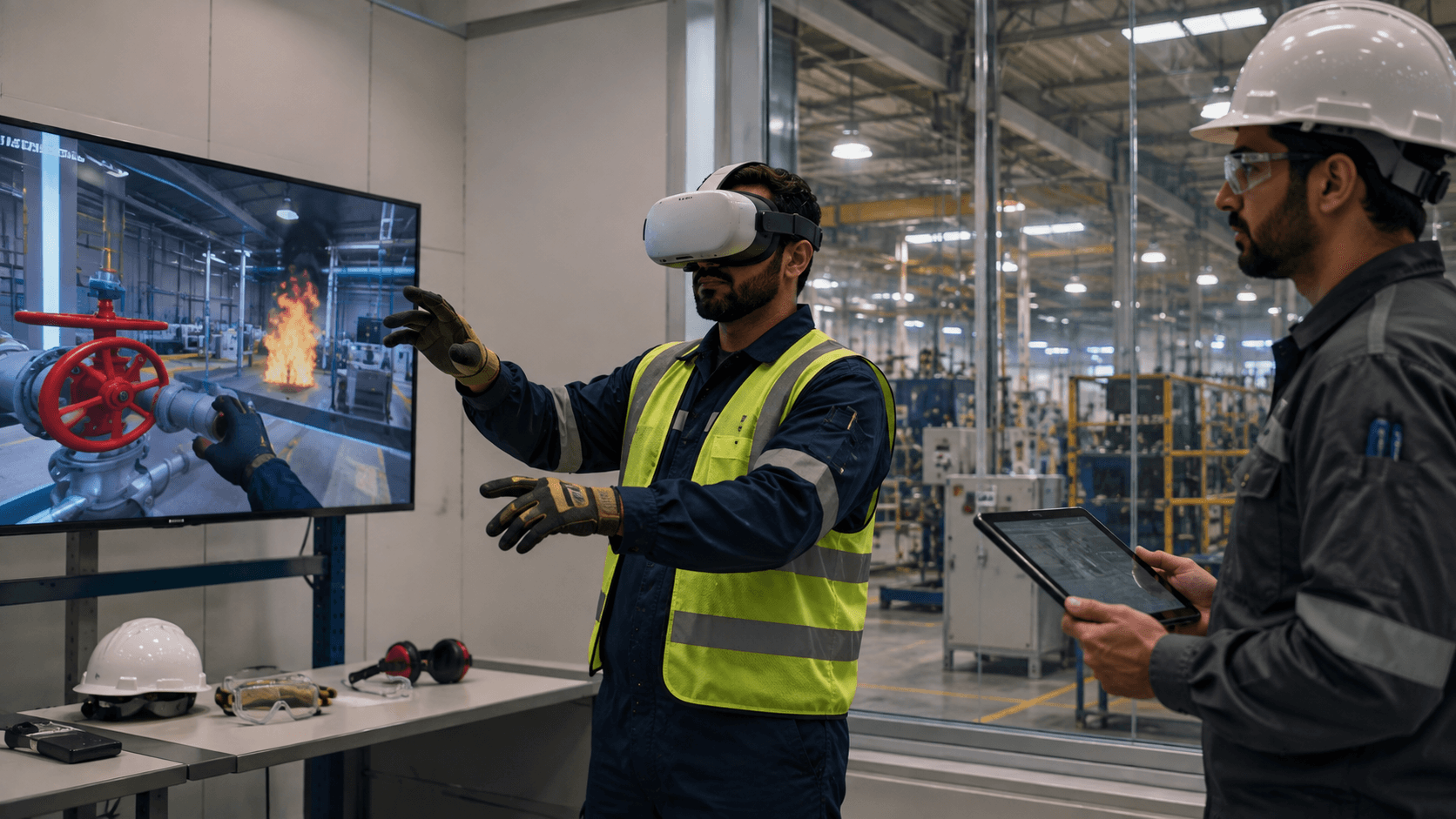
Immersive, VR-based training puts workers into a realistic version of the exact scenario they'll face – equipment operation, hazard drills, confined spaces – without any of the real-world risk. A few reasons this matters more than it might sound:
Repetition without risk. Workers can run a hazardous scenario as many times as it takes to get it right, something no real factory floor can safely allow.
Faster time to competency. PwC's enterprise VR training study found that VR learners completed training up to four times faster than classroom learners while reporting significantly higher confidence applying what they learnt on the job (PwC).
Consistent delivery across sites. A VR safety module trained once can be deployed identically across a Dubai facility, an Abu Dhabi facility, and a Riyadh facility — no variation in trainer quality or coverage.
Built-in progress data. Every simulation logs decisions, reaction time, and errors, giving safety officers documentation that goes well beyond an attendance sheet — useful when MOHRE or OSHAD inspection records are requested.
This is the same shift we cover in more depth in The Factory Floor Where One Mistake Cost Six Figures, where a single preventable equipment error outlines exactly what's at stake when training doesn't transfer to the real environment.

What UAE Manufacturers Should Look For in a VR Training Partner
Not every AR/VR vendor understands manufacturing, and not every eLearning vendor understands immersive design. A few things worth checking before committing:
Industry-specific scenario design, not a generic VR template reskinned with your logo.
Local compliance alignment — training content that maps to MOHRE and OSHAD reporting categories, not just general safety best practice.
Hardware flexibility — support for standalone headsets as well as desktop/AR fallback options for sites that aren't ready for full VR rollout.
Analytics you can actually use — dashboards that translate simulation performance into the kind of records a safety audit expects.
A blended delivery model — VR paired with an LMS so completion, certification, and refresher cycles are tracked in one place rather than scattered across spreadsheets.
Our own AR/VR Learning Solutions page walks through how we approach environment design, 3D development, and analytics for exactly this kind of rollout, and it pairs naturally with a Custom eLearning Solutions build when a manufacturer needs safety training folded into a broader onboarding or upskilling programme.
Building the Business Case Internally
Safety officers rarely control the training budget alone — this usually needs sign-off from operations and finance, which means the pitch has to go beyond "it's safer". Frame it around:
Incident cost avoidance — even one avoided lost-time injury can cover the cost of a pilot VR module many times over.
Faster onboarding — new hires reach competency faster, which matters in industries running near capacity.
Retention of institutional knowledge — VR scenarios can encode the judgement of your most experienced operators into a repeatable training asset, which matters when experienced staff turn over.
Engagement, not just compliance — pairing simulation with gamification elements (progress tracking, scenario scoring, and team leaderboards) tends to lift completion rates well above the “sit through the slides” baseline.
For more context on why this is becoming urgent across the region specifically, see our earlier post, Why UAE Manufacturers Can't Afford to Ignore VR/AR Anymore
Getting Started
A full VR safety training rollout doesn't need to start with every hazard on your floor. Most manufacturers we work with start with a single high-risk scenario — confined space entry, machine guarding, or lockout/tagout — prove the model works, then expand. If you're evaluating whether VR safety training makes sense for your facility, get in touch and we can walk through what a pilot would look like for your specific risk profile.
Further Reading
Similar Blogs you might like




Stay Updated
Unlock peak performance with Maple Learning Solutions. Insider tips, updates & announcements. Dominate the field, stay informed.