Summary
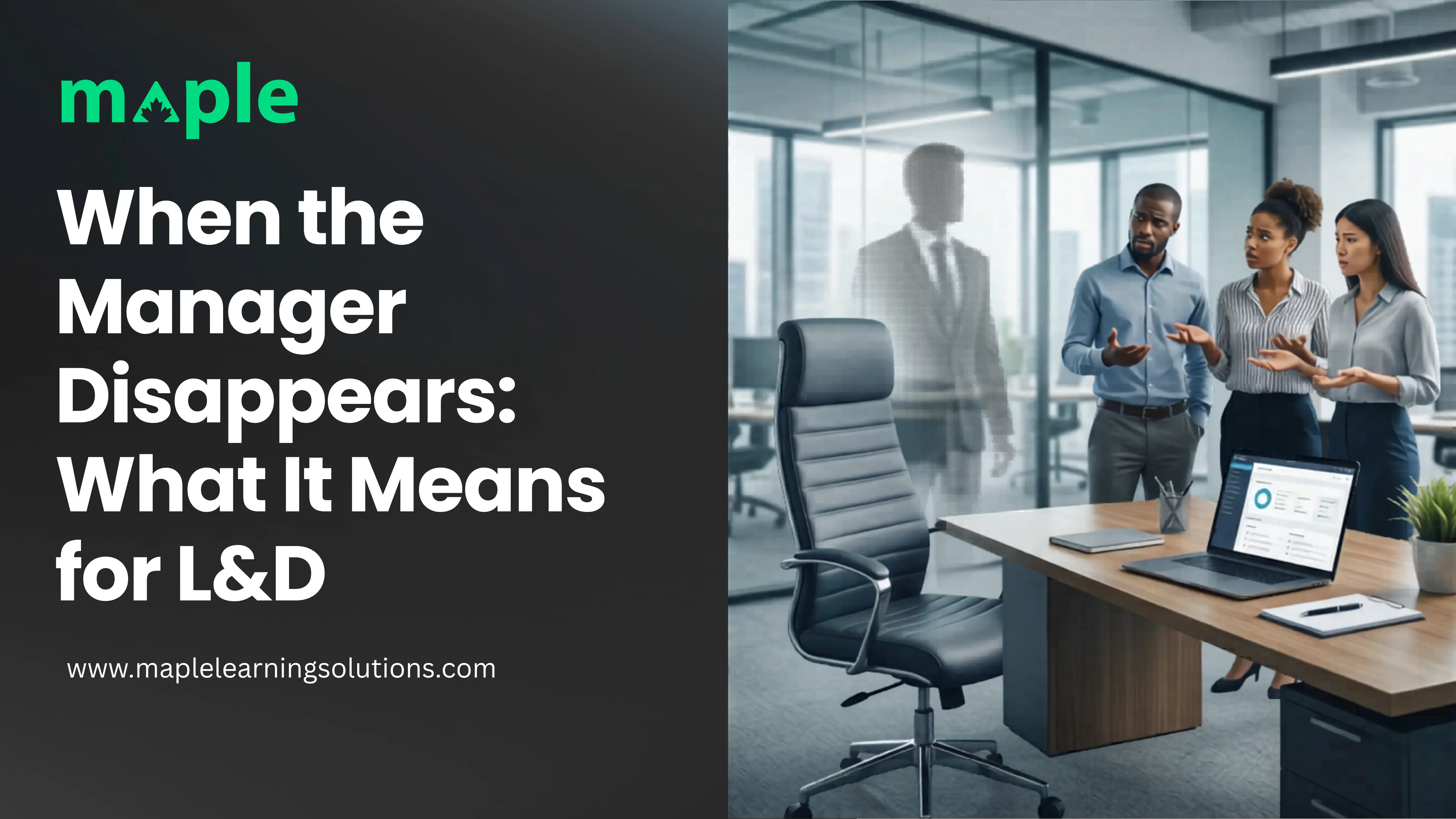
Explore the AI impact on L&D as managers disappear. Learn how organizations must adapt training, leadership, and workforce skills in the AI era
Jack Dorsey made headlines recently — not just for cutting roughly 4,000 jobs at Block, reducing his workforce from over 10,000 to just under 6,000 — but for articulating why. In a blog post co-authored with Sequoia Capital's Roelof Botha, Dorsey laid out a vision he calls intelligence-native organisations: lean structures where AI replaces the coordination and oversight that middle managers have traditionally provided.
“There is no need for a permanent middle management layer,” he wrote.
Block's share price rose more than 20% after the announcement. Investors, it seems, agreed.
But here's the question that should be keeping every L&D leader up at night:
if the layer between senior leadership and frontline specialists disappears, what fills the gap — and who trains people to work within it?
This is where the AI impact on L&D becomes impossible to ignore.
The Three-Role Model
Dorsey and Roelof Botha propose that intelligence-native organisations run on three types of roles:
Deep specialists — experts who take direction partly from AI systems and execute with high autonomy
Senior leaders — who combine hands-on work with developing people (a hybrid of doer and coach)
AI systems themselves — handling the communication, coordination, and oversight that managers once owned
This isn't science fiction. It's already happening at Block, and Dorsey has suggested most companies will eventually reach the same conclusion — a clear signal of ongoing AI workforce transformation.

What This Means for L&D
If this model spreads — and the GCC's rapid adoption of AI in corporate learning across government, banking, and energy sectors suggests it may spread here faster than elsewhere — the implications for learning and development are profound.
1. The coaching and development role doesn't vanish — it concentrates
In Dorsey's model, senior leaders carry a heavier people-development responsibility than they do today. This means organisations need to invest heavily in developing coaching capability, emotional intelligence, and mentorship skills at the top — not just at the middle.
2. Specialist depth becomes the primary currency
When AI handles coordination, the human value proposition shifts entirely to domain expertise. L&D programmes that focus on broad, generic skills may become far less relevant.
Deep, role-specific competency development — built quickly and continuously — becomes the priority in the future of L&D with AI.
3. AI literacy is no longer optional — it's existential
Employees who cannot work effectively alongside AI systems will be structurally disadvantaged in this new architecture.
For L&D teams in the GCC, this means AI fluency training is not a "future skill" initiative. It is a now initiative — a core part of the evolving AI impact on L&D.
4. The skills for human-AI teaming are genuinely new
How do you take direction from an AI system?
How do you know when to override it?
How do you maintain accountability in a flatter structure?
These aren't just technical questions — they're behavioural ones.
And organisations are not yet training for these human AI collaboration skills.

A Word of Caution
Dorsey's model is bold, but it is one data point. Not every organisation can or should hollow out its management layer.
Middle managers serve functions that AI cannot fully replicate — they carry institutional knowledge, manage political dynamics, build trust across teams, and often absorb organisational stress invisibly.
The more useful question is not will AI replace managers? but rather:
Which parts of management can AI do better, faster, and cheaper — and what does that free humans to do instead?
The answers will vary by sector, culture, and context. In the GCC, where hierarchy and relationship-driven leadership remain central to business culture, the transition will require particular care and nuance.
The L&D Opportunity
Disruption always creates a learning gap.
If organisations are restructuring toward intelligence-native organisations, someone needs to help their people navigate that shift. That's not a threat to the L&D function — it's arguably the most significant brief it has ever been handed.
From building digital learning strategies to enabling AI-powered training programs, L&D teams now sit at the center of organisational transformation.
The question is whether L&D teams are ready to move fast enough to meet it.
Key Takeaways
AI is reshaping organisational structures by reducing reliance on middle management
The AI impact on L&D is driving a shift toward leadership coaching and specialist skills
AI literacy is becoming essential for workforce readiness
Human-AI collaboration is an emerging core competency
Frequently Asked Questions
How is AI impacting L&D?
AI is transforming L&D by automating coordination and requiring new skills like AI literacy, leadership coaching, and human-AI collaboration.
Will AI replace managers?
AI may replace certain managerial tasks, but human leadership remains essential for coaching, trust-building, and decision-making.
What skills are needed in AI-driven workplaces?
Key skills include domain expertise, adaptability, AI literacy, and the ability to collaborate effectively with AI systems.
Similar Blogs you might like




Stay Updated
Unlock peak performance with Maple Learning Solutions. Insider tips, updates & announcements. Dominate the field, stay informed.