
Summary
A documented Business Continuity Plan isn’t enough anymore. Learn why outdated BCPs fail during ransomware attacks, outages, and operational disruptions — and what resilient organizations do differently.
93% of Companies Have a BCP. 40% Still Fail. Here's the Gap No One Talks About.
Let me tell you something that doesn't get said enough at the leadership table.
Having a Business Continuity Plan doesn't make you resilient. It makes you feel like you are. And in my experience, that distinction — between actually being prepared and believing you are — is exactly where organizations fall apart when things go sideways.
I've seen it happen. A well-run company, good leadership team, solid reputation. Then one ransomware attack, one extended outage, one supply chain collapse — and within months, they're making decisions nobody ever thought they'd have to make. Not because they didn't have a plan. Because their plan had never been truly tested.
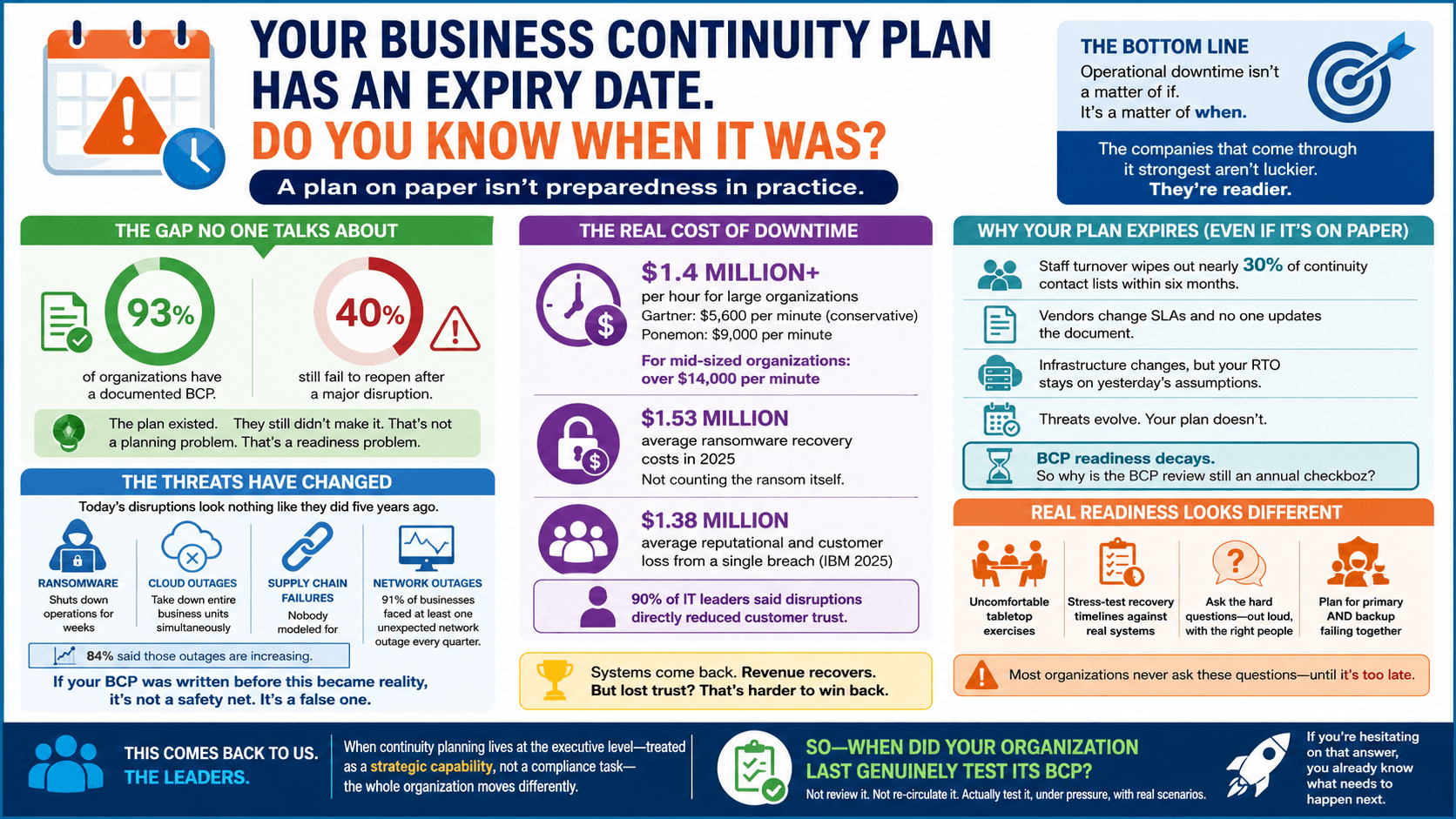
93% of organizations have a documented BCP. 40% still fail to reopen after a major disruption. Read that again. The plan existed. They still didn't make it. That's not a planning problem. That's an execution problem. A readiness problem. And frankly — a leadership problem.
The world your BCP was written for probably doesn't exist anymore.
In 2024, disaster-related costs in the U.S. hit $182.7 billion — the highest since 1980. And we're not just talking hurricanes and floods. The threats sitting on every CIO's desk today look nothing like five years ago. Ransomware that shuts down operations for weeks. Cloud outages that take down entire business units simultaneously. Supply chain failures that nobody modeled for. 91% of businesses faced at least one unexpected network outage every quarter in the past two years — and 84% said those outages are increasing.
If your BCP was last seriously reviewed before any of that became your daily reality, it's not a safety net. It's a false one.

Now let me talk money, because that's the conversation that actually moves things in a boardroom.
A major outage can cost large organizations over $1.4 million per hour. Not per day. Per hour. Gartner estimates downtime at $5,600 per minute on the conservative end — Ponemon puts it at $9,000. For mid-sized organizations, every minute of IT downtime runs over $14,000. One bad afternoon can undo months of margin.
And ransomware? Even with improved backup practices bringing recovery costs down, organizations still averaged $1.53 million in ransomware recovery costs in 2025 — not counting the ransom itself. That's the improved number.
But here's the cost that never makes it onto the spreadsheet — reputation. 90% of IT leaders said disruptions directly reduced customer trust in their organization. IBM's 2025 breach report puts reputational and customer loss from a single breach at $1.38 million on average. Systems come back online. Revenue recovers — eventually. But the customer who quietly moved to a competitor during your outage? They're probably not coming back. And they told people.
Here's the operational reality that keeps me up at night.
BCP readiness decays. Quietly, consistently, faster than anyone tracks. Staff turnover alone wipes out nearly 30% of continuity contact lists within six months. The person who owned your incident response last year might be at a different company now. The vendor in your recovery chain changed their SLA and nobody updated the document. Your RTO was designed around infrastructure that got migrated eighteen months ago.
Your plan isn't static. Your organization isn't static. Your threats certainly aren't. So why is the BCP review still an annual checkbox?
Real readiness looks different. It's uncomfortable tabletop exercises where people realize mid-scenario they don't actually know what to do. It's stress-testing recovery timelines against real systems, not assumptions. It's asking — out loud, with the right people in the room — what happens if our primary and backup both fail at the same time?
Most organizations never ask that question until they're living it.
This comes back to us. The leaders.
When continuity planning gets handed off to IT, it gets resourced like an IT project. Underfunded, under-tested, reviewed when there's bandwidth. When it lives at the executive level — when the CEO and board treat it as a strategic capability and not a compliance requirement — the whole organization moves differently around it.
Operational downtime isn't a matter of if. Nine out of ten organizations experienced it last year alone. The companies that came through it strongest weren't luckier. They were readier. They'd done the unglamorous work — the drills, the reviews, the hard conversations — long before anyone needed to.
That's the gap. Not the plan. The preparation behind it.
So — when did your organization last genuinely test its BCP? Not review it. Not re-circulate it. Actually test it, under pressure, with real scenarios?
If you're hesitating on that answer, you already know what needs to happen next.
Further Reading & Sources
Strengthen Your Business Continuity Readiness
Organizations looking to improve operational resilience, crisis preparedness, and Business Continuity capabilities can explore structured training and certification programs through Maple Learning Solutions GCC BCP Platform.
Similar Blogs you might like




Stay Updated
Unlock peak performance with Maple Learning Solutions. Insider tips, updates & announcements. Dominate the field, stay informed.